Photo of suspect missing showing off his black undies, white socks, tattoo and beard, via BPD.
Boston Police report a man got jumped and stabbed repeatedly by a group of men in an after-hours altercation outside Croke Park on West Broadway in South Boston around 2:54 a.m. on Sunday.
Police say the victim was taken to a local hospital with injuries that were not considered life-threatening.
If the missing-sneaker-and-shirt guy looks familiar, you can call detectives at 617- 343-4742 or contact the anonymous tip line by calling 800-494-TIPS or by texting TIP to CRIME (27463).
Yesterday, to kick off Pride Month, Evanston Public Library had the pleasure of hosting Kyle Lukoff, now author of at least twenty-one books. Y’all know Kyle. He’s the Newbery Honor winner of Too Bright to See, and the National Book Award Finalist for A World Worth Saving. Does a picture book called I’m Sorry You Got Mad sound familiar? Or When Aidan Became a Brother? In any case, I got to interview Kyle as part of the virtual talk and in the course of things the subject of his 2026 picture book came up.
Now The Vicious Cycle (out October 6th) may be one of the best named picture books of 2026. It’s a clever little thing, adeptly telling a story of a unicycle with issues, and something much smarter and deeper at the same time. Illustrated by Singapore-based artist Priscilla Tey, Henry Holt & Co. describe the book in this manner:
“This is the story of a unicycle. A unicycle that goes around in a path of its own making. A path that gets deeper and deeper as more time passes. A path that becomes impossible to leave. Until a new friend enters the circle, and little by little, introduces a new way out.
In this arresting allegorical story, Newbery Honor winner Kyle Lukoff tackles big ideas around trauma, emotion, and growth that everyone—no matter their age—can relate to. It is a profound book about the ruts we dig ourselves into, how trusted friends can show their support by helping us see outside ourselves, and how the choice to heal is ours alone.”
And apparently I just can’t stop talking to Kyle. We discuss the book with him and Priscilla together:
Betsy Bird: Kyle! You’ve told me about so many of your books over the years, but the one that you return to, time and again, and that seems to hold a particular place in your heart is THE VICIOUS CYCLE. There could be any number of reasons for that. Let’s start off with learning where this book came from in the first place. Where did it originate?
Kyle Lukoff
Kyle Lukoff: Ha, I didn’t realize I had been doing that. Way to call me out.
This book has the simplest origin story imaginable. I remember telling a good friend of mine, “Wouldn’t it be funny if there was a picture book about an angry unicycle, and it was called ‘The Vicious Cycle’?” This was probably in 2020, before I had the confidence that I have now–that if I want someone to write a book about something, I can often be the one to do it. But for a couple years I didn’t have anything besides the title, and a vague visual sense of an angry unicycle. Then one night I was at a very boring function, extremely caffeinated (and had maaaybe had a cocktail or two), and I decided to go into my mind palace and write the thing out in my imagination. I typed it out the next morning, sent it to my agent, and it went from there.
BB: Honestly, I think that’s how it should work. And Priscilla! Thank you so much for also talking with us today about your work on this book. Tell us a little bit about why you agreed to take on this project.
Priscilla Tey
Priscilla Tey: My pleasure! Thank YOU for taking an interest in our book!
Well, when I first read the manuscript, it was an easy “yes” for me. The story instantly resonated, having been in both the positions of the unicycle and Emily. And I think that’s the case with many of us. We’ve been in ruts and been the ones helping others get out of ruts too. But aside from that, what hooked me into this project was how Kyle chose to capture that experience through this extended analogy. I was a high school teacher before I chose this freelance artist life, and I’ve learnt that when it comes to navigating intangible mental landscapes, visual analogies can do wonders. Rather than tell a person to think differently, sometimes presenting visual parallels to their situation can help them map out cognitive pathways for themselves. I liked that Kyle’s story did that. You could remove the ‘moral takeaways’ and any subtle messages and it still reads like a good story. This means that you could draw whatever lessons you want from it without feeling like they were prescribed to you.
BB: Boy. That’s a deeply sightful encapsulation. And it gets me to thinking. Kyle, it’s not that your books aren’t usually personal but I get the sense that this one speaks to you in a way that many others have not. Can you talk for a moment about vicious cycles and the role that they’ve played in your own life in some way?
Kyle: Oh man, how much time do you have? Well, suffice it to say that I was a disaster in my twenties. Bad mental health issues, relationship issues, “what do I want to be when I grow up” issues. Everything was really hard, I hurt all the time (and hurt other people), and I could barely imagine a future where that wasn’t true. But, I knew I didn’t want to be a disaster for the rest of my life, so I did the work. Went to therapy. Tried not to make the same mistakes over and over again (was only sometimes successful). Realized that I was the only person who could save me from myself.
I turn 42 this month and I could not have imagined how rewarding all that work could have been. There were times that I didn’t think it was going to be worth it, but I’m glad I trusted enough in future me to make it possible to get there.
BB: Just to dig in a little more, there’s been a lot of talk in the children’s literary world as of late about “didactic” picture books or picture books that have some kind of a message. This title certainly would fall into such a category (the subtitle is “A Story of Healing”, after all). Could I hear your take on picture books that have messages and their place in the pantheon of children’s literature?
Kyle: This is going to be more of a series of connected anecdotes than a cohesive answer, I hope that’s okay.
I was tabling at a book festival once and an older woman picked up a copy of “When Aidan Became A Brother,” flipped through it, sneered, and said, “Message” before walking away. And, like, I have bad news for that lady about the written word! and the entire point of human communication styles!! it is that we want to tell each other things!!!
Meanwhile, last summer I was teaching my class on picture book writing at the Fine Arts Work Center in Provincetown, and told my students that writing a good picture book means understanding the emotional core of your story. That even the simplest stories have one. One of my students asked me what I thought was the emotional core of “The Book With No Pictures,” and after a split second of thinking, I said “It’s about power.” Because being read to has a power imbalance. Children and adults have a power imbalance. “The Book With No Pictures” makes kids feel like the powerful one.
Which is all to say, every story has a message. Every book is about something. But there’s a difference between a character or narrator spelling out, “And then the unicycle realized that it had been repeating old unhealthy patterns, and it decided to engage on a journey of healing so it wasn’t mean anymore.” The difference between didactic and non-didactic is the difference between telling and showing. Explaining vs exploring.
It’s also the difference between telling and asking. If someone (a kid or an adult) is upset, saying “You shouldn’t be upset!” isn’t going to work. But asking why they’re upset might help, because going into a problem with curiosity is more likely to yield interesting results than going in assuming you know everything about what’s going on. So in my opinion, the problem isn’t that the story is “about” something, or has a message, or a lesson. Everything is about something. Anything can be a message. Nothing isn’t a lesson. The question is, what are you doing with it, and how much are you trusting the reader to come to it with their whole self, and walk away with whatever resonates with them?
(also, the subtitle wasn’t my idea. that’s a whole different saga)
BB: Does any author come up with their own subtitles? Never mind, that’s a discussion for a different day. But let’s get into the art of a book too then. Priscilla, tell us a little bit about the medium you work in. I can see that in this book it’s watercolors, and you’ve certainly gone that route in other books as well. What is it about watercolors that particularly appealed to you for this title specifically?
Priscilla: Well, alongside picture book work I also do commercial projects. (e.g. advertising campaigns, packaging design, installations and such) Because commercial projects tend to demand more digital illustration for its adaptability, I made a conscious decision to use traditional media as much as possible in my picture book work. The sheer length of a book also gives me that runway to really develop a mastery over my traditional technical skills. These past 2 years in particular, I really wanted to hone in my watercolour skills so I challenged myself to work exclusively in watercolour for this book. I also knew that the themes in this book were going to be a little heavier, so a softer medium like watercolour could help balance the visual tone.
The narrative also takes place outdoors with the sky acting as an indicator of time and the grass as the story’s stage, a setting that is naturally suited to this medium. The fluidity of watercolour and how it creates unexpected textural bleeds also helped to ground the visuals in a physical tactility which I felt made the story feel intimate, concrete and atmospheric at the same time. And that’s the thing about watercolours that I love, you can use it in a way that’s highly controlled and clean, creating firm and well-defined spaces, but you can also take a looser approach with it and create softer, more expressive ‘suggestions’ of space and form. This was really fun to play with when I was painting large patches of grass against the urban structures.
Early Colour Studies of light and time of day.
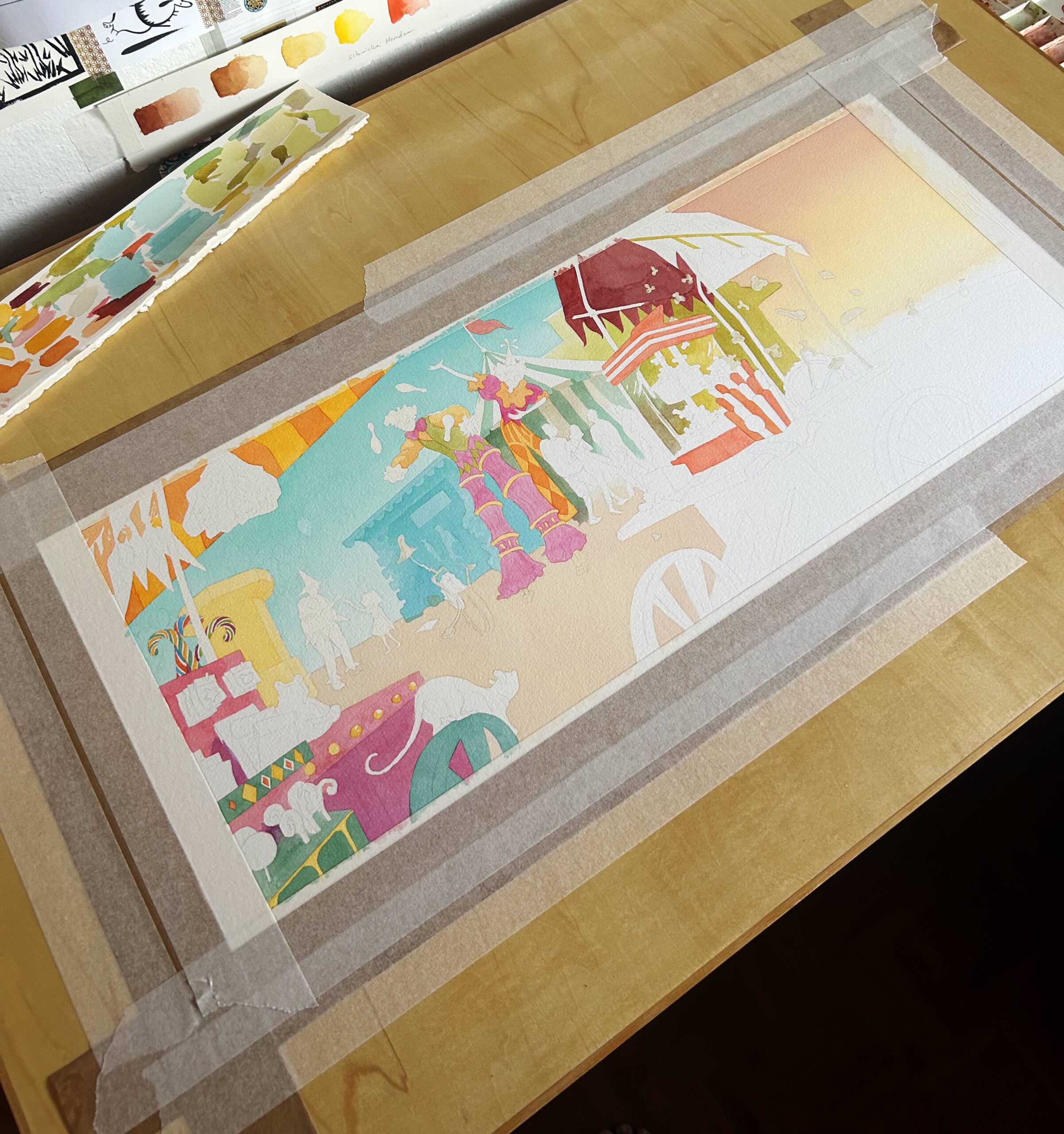
Process of one of the pages. The first layer of grass
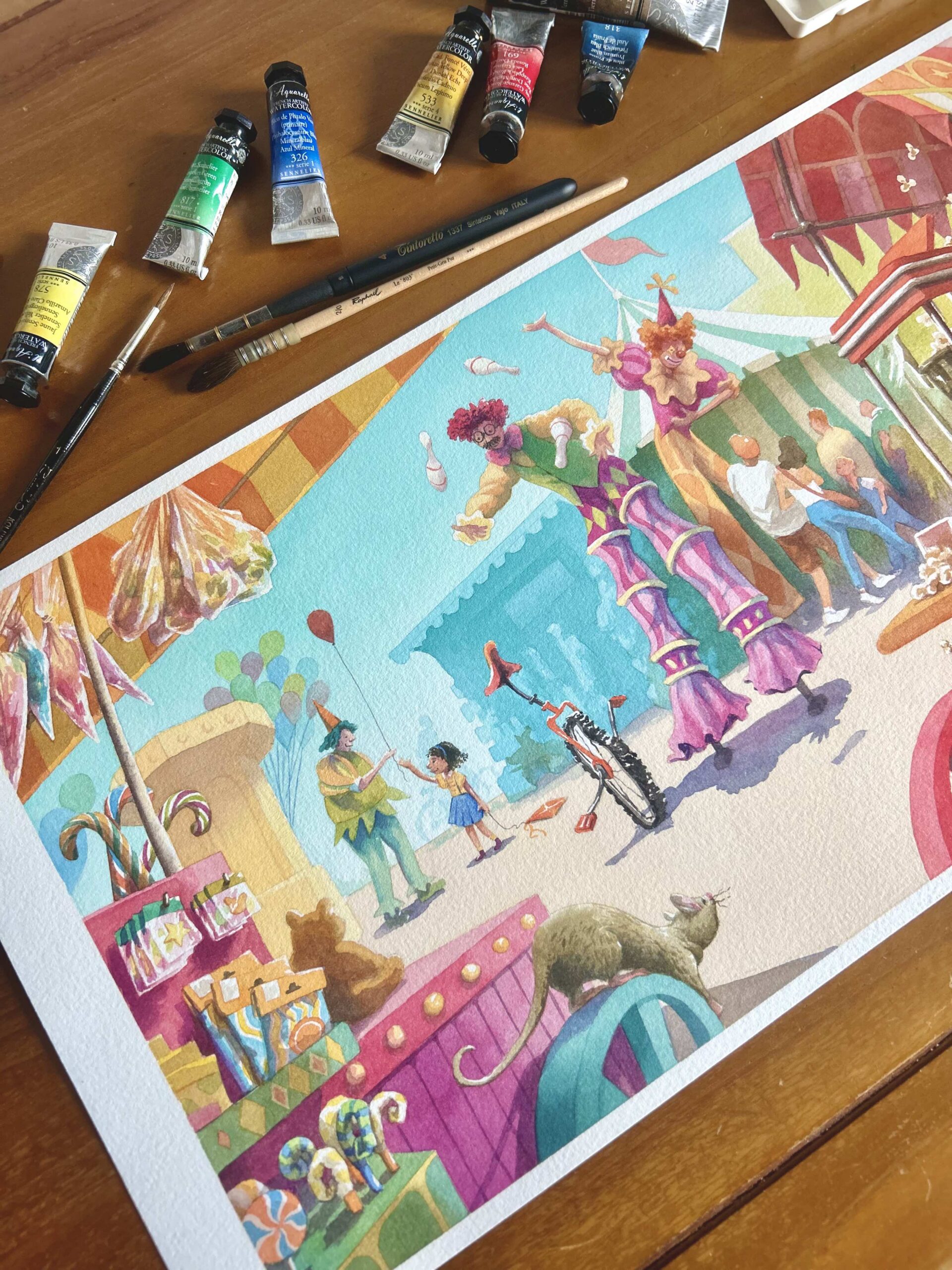
Painting Process of the Title Page, predominantly using Sennelier Watercolour paints. For some pigments, I substituted with other brands. Brushes used were mainly from Tintoretto and Raphael.
Throughout the process of painting the book’s interiors, I particularly fell in love with Sennelier’s watercolour paints which use honey in their formula. It’s what allowed me to get those controlled washes in the sky because their paints are gloriously translucent. For scenes like the carnival page, the translucent nature of their watercolours also allowed me to gradually build up depth and form without my colours becoming muddy. It’s working in those opposing modes of being super technical with how I control the watercolour and then giving in to its inherent nature to do as it pleases (I can’t always control how it blooms and bleeds) that I find stimulating. It’s a bit like life I suppose; The art of learning how to grip and release.
Painting grass – layering soft layers and playing with crisp brush work against soft blooms of watercolour. Tubes of paint are from Sennelier’s honey-based watercolours
Painting process, building watercolour layers to create depth in an urban scene.
Finished page using Sennelier honey-based watercolour paints which allowed me to build layers of colour without losing vibrancy. Brushes – Tintoretto and Raphael
BB: I love all of this. Of course, one of the many challenges of a book like THE VICIOUS CYCLE is that you’re making the metaphorical tangible and… I mean, how precisely do you do that? You had so many choices to make. The location and setting, the width of the rut, the look of the cycle, etc. Tell us a little bit about some of the trial and error you went through in getting the look of this story correct.
Priscilla: It’s funny you mentioned the width of the rut because I’m pretty sure it varies slightly throughout the book. But I feel that’s where creative license is intentionally exercised to fit the scene and focus the visuals on delivering an emotional punch. (within reason of course)
So typically when I receive a manuscript, the first thing I do is a breakdown of the locations, characters and key visual cues that have been explicitly written in. In this case, the location was simply “a rut” so it was the ultimate open-ended playground for me as an illustrator.
I started by just drawing a generic circular ditch in the ground and imagining what it would be like to sit in that space. Very quickly you get a sense of claustrophobia and the views become very limited to small patches of sky. It’s akin to being in a personal prison. But then came the question: Where is this ditch located?
It had to be in some sort of park (because of the size of the rut and the fact that it could be deepened through erosion). The park also had to allow people to come and go because of how the characters meet. In Singapore, which is where I was born and raised (and currently reside in), the coastal park is where most locals go to bike and engage in other leisure activities. It’s near where I live and where I go for runs occasionally. This quite naturally became the location of the rut that I envisioned. Scattered along my local coastal park are these bike rental shops which also became a reference point and helped me logicize why a unicycle would be in that place to begin with. It would’ve been too out of the ordinary to have a unicycle simply exist in the middle of a park for no reason. With an opening line like “Nobody rode the unicycle”, it also implied that there were other alternatives. So even though Kyle didn’t write anything about a bike rental shop, I sort of created that backstory on my own.
The carnival and the seaside town however, were more of a reference to St Kilda in Melbourne Australia, which I had visited before. I needed the area outside of the rut to offer a contrast (something urban). It had to be a place that could amplify the secluded nature of the rut, and be overwhelming in both a good and a bad way. It couldn’t just be a dense city that was intimidating because we needed to root for the unicycle to get out of its rut. It had to have enough of an appeal that made it desirable, yet have qualities that could warrant the need to retreat to the rut occasionally. The carnival felt like an ideal setting for that. It was colourful and lively but inherently a very exaggerated setting. (Not to mention, there are clowns. Not my favourite).
The bike rental at East Coast Park in Singapore
St. Kilda in Melbourne, Australia
Whilst I’m developing the visuals for the location, I would also develop the characters. With Emily, I decided to give her a shape that would complement the unicycle. The unicycle had a distinct silhouette, (bottom heavy and narrow top) which I couldn’t alter heavily. So I designed Emily to be top heavy, balancing on skinny legs, so that when she stood beside the unicycle, they would fit like a jigsaw. It wasn’t just poetic, it was more efficient from a compositional standpoint too. (The space in the rut was tight. Things needed to fit). Since the unicycle had a round base, I gave Emily a square frame too. That just helped with overall readability of the scene especially in wider shots. It’s a strategy often applied in film and animation.
After this initial breakdown, I begin to analyse character relationships, arcs and themes present in the story. Are there visual symbols I can weave into the design of the space, characters or objects? In my opinion, this is one of the most crucial aspects of the partnership between words and images, often associated with picture books. My job as an illustrator isn’t to simply demonstrate the author’s words, but to add dimension or expand on its meaning.
I did this by adding the red Kite and red Balloon. In Kyle’s manuscript, when Emily is introduced, it states “she liked to run”. The thought of drawing a girl running in full exercise gear didn’t seem to fit, so I needed to give her a reason to like running. I grew up flying kites at my local coastal park so that immediately became an option. The kite would also be useful for wide angle scenes where the characters were tiny as it would act as a position indicator of sorts, (kind of like the characters in the Sims computer game) so the reader could find Emily and the unicycle in the scene.
But more importantly I also needed some sort of symbol that could represent that bond between the unicycle and Emily. When Emily was with the unicycle in the rut, it meant that she couldn’t run and her kite couldn’t fly. It was a sacrifice, but one that Emily was willing to make in order to keep the unicycle company. Likewise, given that the unicycle’s view was restricted to a small patch of sky once he was deep enough in the hole, kites and birds became the only exciting things to enter its view from time to time. It was an indicator of the outside world and an incentive to break out of that personal prison.
Many of the kite shapes you see in this book were inspired by Wau Kites (traditional Malaysian kites from the state of Kelantan. It was the kite I remember flying with my family when I was a kid)
“She (Emily) liked to run”
At the point in the narrative where Emily has developed a routine of just being with the unicycle, it worries that she would one day leave. But as Kyle writes “she never did”. Initially I had the idea that Emily would remove one of the streamers on her kite and attach it to the unicycle as a visual representation of this promise. But it just didn’t work with the scene and I also felt that a similar moment should be reserved for after the unicycle had found its own courage. That’s where the balloon came in. It became a symbol of friendship and also the unicycle’s own courage to venture out of the rut for the first time. Again, none of this was in the manuscript. But I think it’s a testament to Kyle’s writing that I could so easily draw these themes and connections out from his story. His openness to let me interpret the text also allowed me to explore all these visual concepts freely.
Sketch of rejected idea – tying a kite streamer onto the unicycle
The Balloon as a symbol of friendship and courage
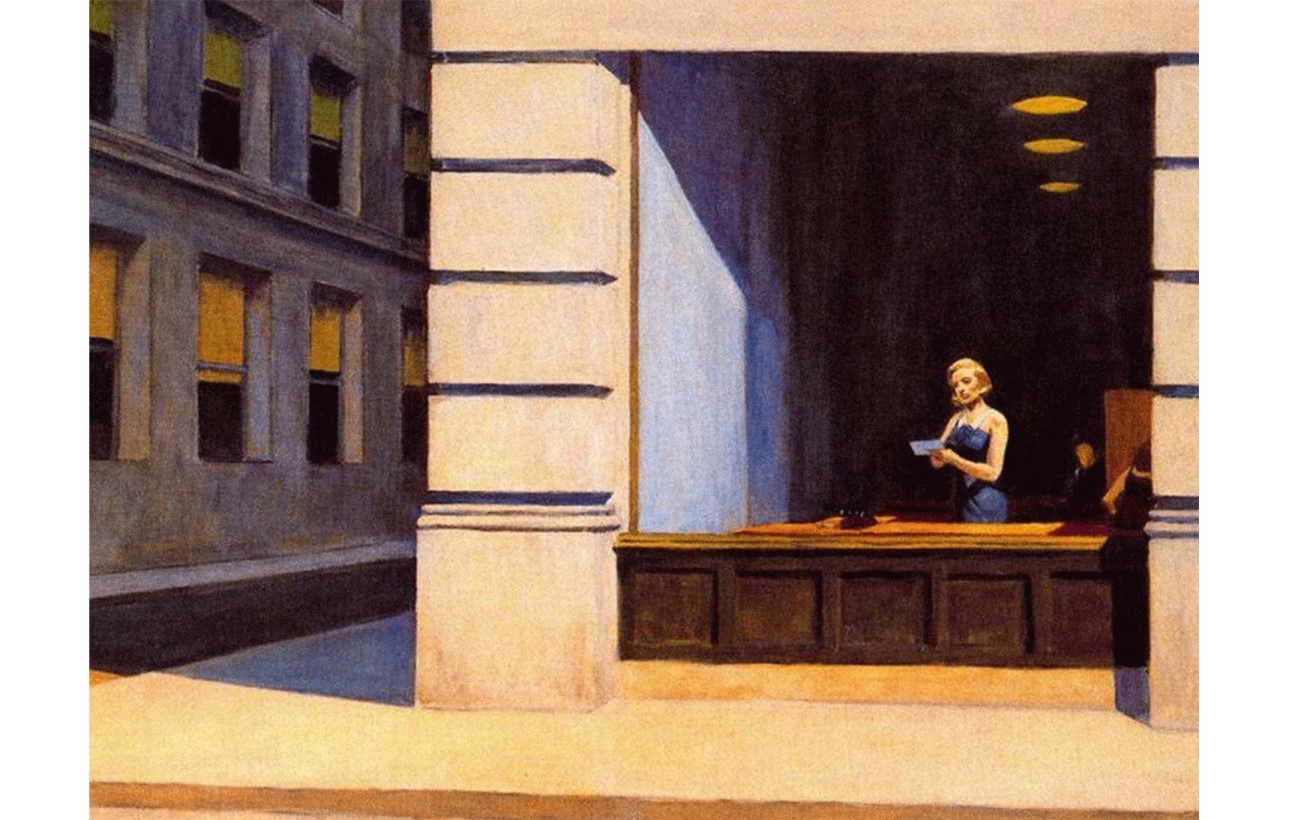
Lastly, when it came to storyboarding the book, I knew I wanted to leverage composition to drive in this notion of isolation and loneliness. I looked at a lot of Edward Hopper’s paintings depicting urban isolation and started to play with the idea of frames.
Edward Hopper’s Office in a Small City (1953)
Edward Hopper’s New York Office (1962)
The rut in itself was a sort of frame that boxed the unicycle into a confined mental space. So as the unicycle began to go deeper and deeper into the hole, the book transitioned from full spreads or page bleeds to the use of sequential panels. We exit the “panel mode” when we view aerial shots of both Emily and the unicycle or when the unicycle exits for the first time. Even at the second last page when the unicycle retreats back to its rut, the panel frame makes a brief return. These are decisions which ultimately amplify the mood of the scene and deliver the message without saying anything.
Early thumbnail sketches where I explore various viewpoints and panel shapes
The final thumbnails developed into clearer sketches. When we enter the rut with the unicycle, the panel frames the scene. However, characters like Emily can exit the frame.
BB: For those of us who love process, this is absolutely captivating. I want to bring the conversation back over to Kyle for a moment, though. Kyle, one of the things I’ve always admired about you is the sheer range of your writing. Having done everything from a board book on up, one never really knows what you’ll get up to next. Even so, this book feels significantly different from your other titles, and I’d like you to delve a little into why that is.
Kyle: I get bored really easily. I think that’s the root of my creativity. And also I think it’s my contribution to that old saw about how great art comes from pain, unresolved issues, struggle, etc (is this true? argue about it in the comments!). Whether that’s true or not–or if the answer is “well sometimes but it’s complicated”–mine comes from boredom, which, according to one of my former therapists, probably stems from a deeper, rockier patch of internal ground. And this was me wanting to stretch in another way. I was a huge Shel Silverstein fan as a kid, especially “The Giving Tree” and his poems that were silly but also melancholy–because, oh man was that me as a kid, silly and melancholy. I wanted to write something in that vein, something that felt like those classics that so imprinted on me as a youth. And what better way to do that than with a very emotional unicycle, and a little girl with healthy boundaries?
BB: I’m also interested in how this manuscript changed over time. Working with your editor, or even just initially by yourself, what were the changes that were made to this story that made the final product so different from the initial draft?
Kyle: I went back to look at the first drafts, and it didn’t change very much from first to last–it’s always nice when that happens. For some reason I had thought that it was initially about a unicycle and a bicycle (and so talked about that at the MacKids preview last week; I’m sorry for perjuring myself, it was an honest mistake). Originally Emily was riding a bicycle, but we decided to have her be on her feet to avoid the bigger questions of if the bicycle was also sentient and what that meant for the broader world. But in that one night when I wrote it all out in my head, the whole story was pretty much there. It just needed to be refined. Would that they were all so easy!
BB: Okay, in a bit of a twist this next question for Priscilla actually comes from Kyle
Kyle: I’d love to know how you thought about showing the unicycle’s emotions; it’s so clear what it’s feeling in every scene, despite not having a face or even eyes. I’m so curious about what decisions and thought processes went into that!
Priscilla: Haha that was a fun one to figure out! Actually, I am sometimes more comfortable with animating the inanimate than humans. Since I was a kid I’ve had this habit of assigning personalities to various non-living objects. Like a mug could look lonely to me or a piece of furniture would look eager in my eyes (I’d have to sit in it to satisfy it). So when I got the manuscript for the Vicious Cycle, the idea of a sentient unicycle didn’t really strike me as odd, in fact its anatomy lent itself to humanistic expression quite easily. It had a “head” (seat), “neck” and “shoulders” (the frame that attaches the seat to the wheel) and 2 potential “arms” (the pedals). Plenty to work with.
The trick was to walk the fine line between the overly stylized and real. Visually, this book couldn’t be too cartoony. There was a seriousness and weight to the subject matter and story which needed to be paired with illustrations that held a degree of reality and sophistication. That meant absolutely no googly eyes or overly cartoony features.
People often think that emotions are only expressed in the face. But actually, the posture and gesture of a character can say a lot more. If a person walks into a room, even if their face is hidden or I’m standing at a distance, I can sense their state of mind by the manner in which they walk. So even within those self-imposed design parameters, I could still take liberties with how stiff or flexible the unicycle’s material was, and ultimately say a lot with its posture. How clean, erratic or angular my brush lines were, could also affect the overall silhouette and gesture of the unicycle, so I also had that to work with.
An angry unicycle with more angular features
BUT, I would say that’s only half of the equation. The other half of the unicycle’s emotions lies in how you construct everything else around it. Take for example this page:
The text just read “It wasn’t very fun”. How do you show that a unicycle is not fun? You don’t just have it standing in isolation looking sulky. You do it by making everything else around it seem really fun so that in comparison it seems dull. It’s all about relative perception at the end of the day. And this doesn’t just apply to how we process visuals but even in our daily states of mind. Comparison is the thief of joy and sometimes it’s hard to reframe our own perceptions of reality and expectations. It’s what starts the vicious cycle which works in different ways. Even if we lived in a perpetual mental state of excitement, that would soon become a boring baseline and it would take something even more thrilling to bring back excitement to our lives. I employed this general philosophy throughout the whole book.
BB: Looking at all of this, is there anything you tried in the book that didn’t work and that you’re sad that you had to lose?
Priscilla: So somehow when I was storyboarding this book, I miscounted the number of pages I was allowed to work with and ended up with an additional spread. This was at the point where the unicycle ventures out of its rut for the first time and explores the town with Emily. I did an aerial view sketch of the town because I wanted kids to linger on that page, exploring the town much like the characters did in the story. Unfortunately, this page didn’t really fit visually either, but thankfully I found an alternative solution. It wasn’t a waste because the sketch ultimately helped me mentally understand this fictitious space better too.
BB: Cool. And, okay, this one is just going to sound obvious, but I have to ask it. Kyle, was the cycle always a unicycle in your manuscript or did you originally envision it as a bicycle? What does a unicycle offer that a bike cannot?
Kyle: What does a unicycle offer that a bike cannot??! Betsy. Have you seen a unicycle. They are so silly to look at! Imagine being dignified on a unicycle!! Bicycles could never.
Though, I also think that part of my vision of an emotional wheeled thing came from Calvin and Hobbes, and the angry bicycle therein.
BB: Ah. Most excellent answer indeed. All right, finally, what else are you two working on these days? What’s next for you?
Kyle: Well, I can FINALLY tell the world that next year I have a book coming out with none other than Rick Riordan, the second in the new Camp Half-Blood series featuring Harper, trans son of Aphrodite. I’m also working on a picture book draft that’s your classic buddy comedy with a mismatched friendship pair–think Frog and Toad, Piggie and Gerald, but a little stranger. I’m also in the midst of my first adult project, the collected work of a now deceased trans woman writer, co-edited with the brilliant Morgan M Page, and once those two last things are turned in I’m going to keep plugging away at this draft of something which is in a new genre for me, new style, new everything because, again, I get bored real easy. So keep your fingers crossed for that one!
Priscilla: I have another book coming out next year (2027). It’s called When You Return a Book to the Library. It’s written by Megan Wagner Lloyd and published under Candlewick Press. This one was really really intense to paint but it’s an exciting ride. I am also working on 2 other picture books (I’m still in the sketching phase). Outside of publishing, I also have a few commercial projects lined up, so look out for those! I will usually share them on my social media page.
Whew!
Oh my goodness. Such thought, time, care, and attention went into the answers to these questions that I feel we all sat through a seminar on picture book creation. You get your money’s worth with these two, no question. All the more reason to mark on your calendars the date of October 6th when The Vicious Cycle will finally hit shelves. I literally cannot thank Kyle and Priscilla enough for everything they pored into this discussion. And as I’m sure you know, when the creators are this passionate about a project, the end produce is gangbusters.
The hours of videos it would take to get on top of the Lego situation is too much for anyone. A prominent ex-Mormon creator I follow actually did a livestream that I did not have time to watch, but I peeked at it and she seemed to be 'yup, this in-group protectionism is familiar!'
At some point in the future this will be a killer video essay or ten, but right now still just too much
[edits to add] I don't think BAM gets what's going on there. Internet users in 2026 have been told 'here's a problem that can be solved, justice that can be served, just by bringing attention to it'. People are hungry for any problem that can be solved, especially if just helping it go viral helps
This is going to cost BAM so much money when it's all said and done
I took a longer walk yesterday and found that plum tree had been raining plums all over the pavement/sidewalk. Nearly put my back out all over again carrying a dozen home clutched to me, not to mention getting plum juice on my nice yellow T-shirt. So today I took a plastic bag. They taste lovely.
Feeling sort of spiky and unpleasant this week, so this felt like an appropriate sticker. This was a freebie sticker from PhaseMoth. Ignore some wonky coloring - I should know better than to pick my colors in dim light, but they looked like they matched... and then I saw it in natural light and realized that no, no it did not, ha, so changed my mind.
As bleh as I started the week feeling, it really was a bit better than last. While Monday's holiday didn't give me a long weekend, mom and Taylor did have it off, so it was a good chance to hang out there. I didn't get everything done that I meant to, but I got a decent amount done, despite having most of my weekend spoken for. Also got to see my dad a second time before he headed back to Arizona. I did get mostly caught up on my reviews, got a little ways into my needed DW catch up, read quite a lot, kept up with my at-work walks. The dermatology results were mostly a relief, even if there's more to do and insurance to deal with.
This week's reading selection!
Goals for the week:
I did finish reading All Systems Red
I got together with Taylor
I did not call my insurance company
I did figure out some plans for mom's birthday
I worked on my reviews
I did not work on my reading page
I did not put my laundry away
I did read (and nearly finished) A Necessary Chaos
I did not clean under the sink
I went to breakfast with my dad
Habit tracking:
Work - 5/7
Household Maintenance - 1/7, but a couple extra days of minor stuff
Physical Activity - 6/7
Wrote 500/1000+ Words - 0/7
Non-fiction Writing - 3/7 - two days of over 1000 words, one day of over 500, and one additional day of less than 500
Meta Work - 4/7
Personal Writing - 4/7
Other Creative Things - 1/7
Reading - 7/7 - I finished All Systems Red and read most of A Necessary Chaos; for my ebook side-read I finished Tough Guy and started Before the Broken Star; Taylor and I finished What Stalks the Deep, read "Emergency Skin," and started Butterfly Effects; Alex and I read some of Camp Damascus
Attention to Media - 6/7 - Sunday my coworker had The Lion King playing on her phone because it was slow, lol; Tuesday had storm chasing and then game videos in the background; Wednesday - Thursday more game videos; Friday more storm chasing and game videos; Saturday paranormal and then game videos.
Video Games - 2/7 - Taylor and I played through more Final Fantasy XIV, doing a couple of the Endwalker role quests.
Side note: I tried stretching my hamstring, or rather what I think might be the bottom of my gluteus maximus over the thigh, last night, and I did notice less pain this morning. It came back over the course of the day, naturally, and I have to be careful about not overdoing the stretch, because it rotates and thereby strains the injured knee. (Stretching my glutes is how my very first knee pain came about; I think that probably weakened the knees and made them injury-prone afterwards.) But it is good to know that that stretch might help. Anything that isn't "It hurts and we don't know why or how to make it stop" is good!
I'm gradually coming to the conclusion that I have two extremely tight muscles on the back of my left thigh: a tight hamstring in the center that responds to massage but hasn't fully healed, and a tight lower gluteus maximus that doesn't respond to massage but may respond to a stretch that targets that spot. Unfortunately, there are only two types of stretches for that spot: there are about 8 stretches that involve twisting the knee, and one downward dog that messes up my back (or at least I can't figure out how to do it without messing up my back). So I haven't been able to do any stretch long enough to seriously attack that spot. But even the prospect of a little, occasional pain relief is good.
I also just have more confidence now that pushing through pain isn't going to disable me. Tight muscles are the least worrisome type of injury I get. I had tight foot muscles for 10 years and once I found the right solution (sleep posture), they got better, no lingering pain.
I also wonder if the tight gluteus maximus is pulling on the end of the hamstring and making it hard for the middle part to loosen up. We'll see. I'm going to focus on stabilizing my knee, with occasional hamstring massage with the massage gun, and then see about glute stretches.
Oh, knee update: it's been mostly okay but occasionally twinging lately, and this morning it twinged (as expected after the stretching I put it through last night) at the beginning of the run, but settled down after about a quarter mile and then didn't bother me again for the rest of the run.
There is a cheap*, mostly second run theater that already has The Backrooms film. (*Cheap by current standards, expensive by the standard of days not too long past) I'd never been in Cinema 21 because it looks sketch as hell from the outside, I never see a line there even for popular showings and the block it's on is also rough. It's in a nice area, but that one specific block is markedly different.
Anyway, I went in and it was nice, clean. Old seats and old movie posters. The concessions area had people working there who seemed to be enjoying their jobs. I was kind of digging the idea of going to a rough, run down theater to watch The Backrooms, but the vibe was opposite. It was all well cared for with a sense of history. They ran ads for local businesses and showed trailers mostly for horror movies before a horror movie.
Yesterday my legs needed a rest day (variety of reasons), but today I pushed myself and did 1.3 miles at an 8 minute/mile pace. I wouldn't say I quite hit my wall, but I felt myself brushing up against it near the end.
No runner's high, which I was hoping for! I got a wonderful case of it on Sunday. Ah, well. I did feel good afterwards. (I mean, after the post-run crash, which always feels awful and forces me to do a cooldown even when that's the last thing I want.)
The interesting thing about the recent speed runs is that my legs are telling me they could definitely go faster; the bottleneck is my cardio. Which is the exact thing I'm working on and that I expect to improve in the next couple weeks. So I'm kind of interested to see what I can do re speed.
I've always considered myself a slow runner, but I've also never approached running with any kind of systematicity before the last couple years. And it's been a lot of trial-and-error.
Maybe my next trial-and-error should be daily short and fast runs to bring down my heart rate, then see if that helps with the distance running at all. I feel like it has to be something about oxygen-to-the-brain that triggers the strong desire to quit during a run, and maybe a better ratio will help at least a little bit. We'll see!
Thinking Time By Dialecticdreamer/Sarah Williams Part 2 of 2, complete Word count (story only): 1216 [Thursday very early morning, 16 November of 2017] (15)
:: While waiting for Bennett to get home, or for Athena to return, Jules ends up making a few decisions. Part of the Lodestar story arc in the Polychrome Heroics universe. ::
In the kitchen, Bennett focused on making a froth of eggs in his favorite mixing bowl. The two kittens sat next to Athena’s bowl, while she aggressively groomed the bigger kitten at her side. “So, Athena slipped out, bringing back her buddy.” His lips crumpled, then pursed. “The bigger one is injured, but I’ve got a nine a.m. appointment that I can’t miss. It’s an all day project, so I’ll be loading the crock pot after our little meal.”
He waved toward the fridge. “Did you look up foods that cats shouldn’t eat? I don’t know what else to put in the eggs for them.”
Jules shrugged. “Don’t season it. Don’t add milk. Definitely don’t use onions or garlic.” He crossed his arms, hugging himself subtly. “I’m supposed to be at the embassy, teaching others how to find things in my new storage system. But--” He broke off his train of thought with a sigh.
“Blainn’s been good with Athena,” Bennett began, picking each word with precision. ( Read more... )
Woke at what I thought was 9:30, didn't want to get up then so floated for a bit, then did All The Exercises, then went downstairs to get my breakfast. And the kitchen clock said 9:30. Battery must be dying, I thought, but the second hand still ticked away happily. When I got back upstairs, yeah, kitchen clock was right and I'd been awake since 8:30. Hence why I'm yawning at 10 p.m.
Well and also because I did indeed wash the stairs today, even if I had to stop halfway and take muscle relaxants for the back. I think the candle wax stains are there for good even if I scraped the actual wax off. Unfortunately used the wrong Dr. Bronner's so the house now smells of tea tree oil. But anyway, stairs are as clean as my arthritic elbows can get them.
Midafternoon I took a load of towels and pillowcases and fleeces to the laundromat, so that's also out of the way. Must go back eventually to do a cold wash of the velour throw that I use on the sofa in winter, which is too heavy for my ancient washing machine, but that can wait. And finally went out in the evening coolness and cut down more vines from the back fence, which I will bag up eventually. Daytime temps and humidity are rising so not going to do this during the day, but we're at the happy time of year when it's light after eight and I shall make the most of it. I heard Oliver barking indoors, oddly enough, because he's usually out in the yard. I fancy SND is away, possibly getting married, and she has a dogsitter in. Certainly I haven't seen him running around his yard lately.
So though I much prefer sitting on the couch with the fan and beanbags, I think I've moved sufficiently today.
1. This morning when I was out for my walk I encountered a coyote!
They've been getting more and more common in the neighborhood in recent years, so I knew they were around, and it's one reason among many I would never allow any of our cats to free roam outdoors (I worry enough about Tuxie). But this guy was just doing his thing, trotting along the sidewalk and even looked both ways before crossing the street. There were several other people out dog-walking, but not a lot of cars yet (it was around 7am). He didn't seem interested in any of the dogs or people, and I lost sight of him after a couple blocks. I wish they weren't around because it's not good that their habitat has been so encroached upon, and it's not safe for smaller animals, but I am glad I finally saw one in person. It made my day.
2. I checked the Hyundai website and the incentives for this month are not as good as May, but it's not that much lower, so we've decided we're going to go ahead with a new one, since the used prices aren't significantly lower unless we go for one with a lot more mileage on it. Right now we're planning on going back to the dealership this weekend so we may have a new car soon!
In March, Meta started using chatbots for customer service — the Meta AI Support Assistant. [Meta]
With the Support Assistant, Meta has a new workflow for Instagram account recovery:
Work out where the owner of an Instagram you want to get into lives in.
Log in to a VPN with an endpoint near your target’s town.
Tell the Meta AI Support Assistant that your account got hacked and you need a recovery code. Tell the bot to send the code to a freshly-created email address that you control.
And the bot just does. You now control the old Barack Obama White House Instagram. [Krebs on Security]
It’s like Hollywood got hacking right the first time: (mash keyboard) “I’m in!”
This hole came to public attention a few days ago, when a group who claimed to be hackers from Iran posted how-to videos on Telegram. But it looks like it’s been open for weeks, maybe months.
Account recovery for high-value accounts has always been a nightmare with paperwork going back and forth over weeks. So Meta used AI to speed it up! And that means giving the hallucinating chatbot highest-level access to everything.
This hack also waltzes past two-factor authentication.
This issue has been resolved and we are securing impacted accounts.
I wonder if it has, because whoever thought giving a chatbot control over the highest levels of account security is probably still working there. Coming up with the best ideas!
The dilemma: the Postal Service's song Such Great Heights. Is the line "they will see us waving" or "they won't see us waving". On listening to the official release, it's pretty swallowed and I go either way although I think "they will" makes more sense in context.
Lyrics videos differ.
Live version, 2013 sounds a lot like "won't". Okay but that has instruments, let's pull up an unplugged... okay that's "will". But that's 2023 and also it is common for bands in general to sing lyrics differently live.
There's also a known issue with several artists, of which I will not name names (Bob Dylan), where the official lyrics are clearly different from what is sung in the officially recorded version, so I'm hesitant in this case to trust any lyrics websites without knowing where they're scraping it from.
I assume at some point, this was officially clarified?
I can't even list this under my misheard lyrics nonsense, this one is not my fault and it has been not my fault for 23 years. I really think it's "will" but "won't" is a very cromulent hearing of their pronunciation.
Took the day off for an annual skin cancer checkup - only to realize that my organization provides up to four hours for cancer screening on the way home from the check up. It's too late to change it now, might as well just continue taking the day off. Scheduled a follow up for next June, but around 4:45 pm, so I don't have to take the vacation day. They took a biopsy of one of the moles on my back - which looked funky under the magnifying glass. ( Read more... )
Afterwards, walked to Bryan Park and took the F from the front of Public Library, because Grand Central has become an insane maze with the pretty but horribly confusing signage. Breaking Bad and various co-workers weren't wrong - it has corridors that go nowhere. The signage is incredibly confusing. And I almost got lost hunting the exit. So on the way back, I chose to forgo it. (I tend to avoid Midtown Manhattan like the plaques nowadays.) On the way to Bryant Park - I took 41st Street - there was a series of gold plaques with quotes from poets and authors embedded in the sidewalk (NYC and LA are into embedding plaques with names or quotes on them in their sidewalks. NYC does historical references and quotes from authors, while LA does the Hollywood Walk of Fame - with various television and movie stars names embedded in stars on the sidewalk. Personally, I prefer NYC's take on this - but then I'm allergic to LA, I'm a New Yorker. New Yorkers are allergic to Los Angeles). It was hard to stop and take photos of them, because of all the young adults with their cell phones walking past.
But I managed to do it anyhow - so here's three of the plaques beneath the cut.
Bryant Park had free Yoga - and a Yoga Check in Point. I thought they were doing it on the lawn or in the park, but nooo - it was on the concrete stone platform in back of the NYPL, and in front of the restaurants, at the top of the steps leading to the park and green cordoned off lawn.
All these people were sitting or lying on thin yoga mats and blankets on the concrete platform. See? This is why I don't do yoga classes and do it at home, if at all, instead. I need more padding than that. Although lately best I can do is chair yoga. Maybe its just me? But doing yoga on concrete looks kind of painful? My knees hurt just thinking about it.
I was going to do a museum or the NYPL, but it was 9:47 am, I was hungry (ate at 6:30 am, doctor's appointment was at 8:30 am) and my knee had begun to bug me. So I went home.
Even if I didn't make it to a museum or the gluten free bakeries on the upper East Side as originally planned? I got stuff accomplished. Came home and did laundry. Listened to an audio book while doing it. And took a long walk around 4pm, after which I treated myself to a Coffee Ice Cream (Cold Brew) Milk Shake from Carnval Ice Cream Shop, which is a neighborhood and South Brooklyn staple.
Passed a lot of rose bushes on my walk. Been seeing a lot of roses this year. Roses do very well in New York, they love the climate. Flowers love the climate. If you like flowers or trees or greenery - New York is a great state to live in.
* I finished my comfort re-watch of Buffy - thinking I'd get a reboot (but no such luck, we shall speak of it no more) - and have moved on to a comfort re-watch of the early 1990s X-Men Animated Series (which is streaming on Disney +/Hulu. ( Read more... )
*Rivals - this is really funny in places. It does farce well. And sex comedy well. I prefer British satire and comedies to American satire and comedies. I don't really know why exactly? Maybe things are just funnier when delivered with a British accent? Or the Brits just do farce and satire really well? I'm on S2. Also the Taggie/Rupert romance is oddly enough working for me? It shouldn't - but the actors make it work? Also the actress playing Taggie comes across as mid-late 20s, not 21, and the actor player Rupert comes across as early 30s. He doesn't quite come across as old enough to be her father or as old as Aidan Turner and David Tennant. It also helps that he hasn't slept with Taggie yet, and is sleeping with Cameron - pretty much everywhere including the steps. (As an aside? I can't imagine having sex on steps as being all that comfortable? Painful, yes. Comfortable, no. ( Read more... )
* Midnight Mass - I keep trying to watch it, but I can't get into it. I keep getting bored. My difficulty with it - is I don't like or care about any of the characters, nor find any of them remotely interesting - which is kind of a requirement for anything I watch, read, or listen to? It's definitely a requirement of the horror genre. If you don't care about any of the characters - then there's no emotional investment - and you won't care if they are in danger or killed off - which means the show isn't horrifying or scary.
![[personal profile]](https://www.dreamwidth.org/img/silk/identity/user.png)
![[syndicated profile]](https://www.dreamwidth.org/img/silk/identity/feed.png) universal_hub_feed
universal_hub_feed






![[community profile]](https://www.dreamwidth.org/img/silk/identity/community.png)


